Soft Robotic Lung Catheter
What I did
- Designed an LED-lit imaging enclosure, using shadow-dilution ideas from surgical lights, for repeatable data collection
- Integrated a Maxon motor and NEMA-17 linear stage to add rotation and translation to the catheter
- Designed and printed the custom mounts; proposed the initial project concept
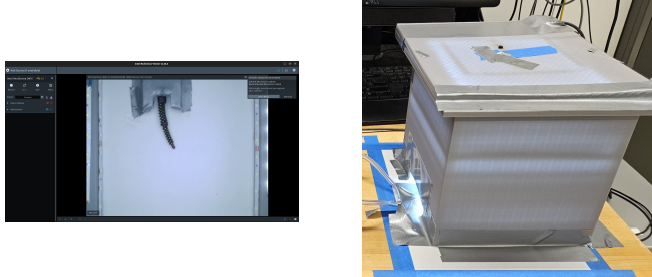
Lung needle biopsy is a common but risky procedure requiring precise navigation through the ribs to reach tumor sites. This project developed a proof-of-concept 4-DoF soft robotic catheter system aimed at safer, more precise lung biopsy navigation.
My primary contributions focused on the hardware infrastructure. I designed and fabricated a custom enclosure featuring strategically placed LED strips based on the shadow dilution principle used in surgical lighting, this ensured uniform, glare-free illumination for reliable camera-based tracking during data collection. The enclosure was 3D printed in Prusament PLA Galaxy Silver with roughened surfaces to minimize reflections.
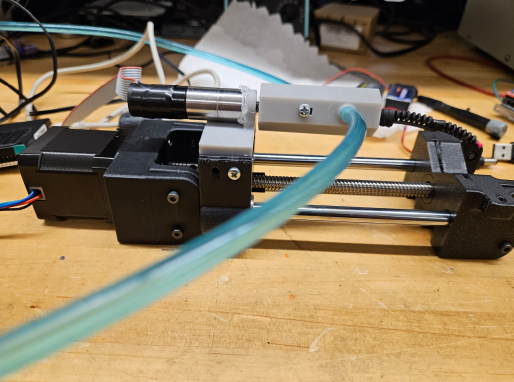
I also designed and built the range-of-motion extension system, integrating a Maxon combination motor with a NEMA-17 driven linear stage. This added rotational and translational capabilities to the existing 2-DoF pneumatic catheter, creating a 4-DoF system with a larger workspace.
I designed the LED-lit enclosure using the shadow-dilution principle, and integrated a Maxon motor with a NEMA-17 linear stage to add rotation and translation.
Problem Statement
- Need: Lung needle biopsy is a common but risky procedure requiring precise navigation through the ribs to reach tumor sites
- Challenge: Soft robotic catheters offer compliance advantages for navigating tortuous anatomy, but suffer from limited degrees of freedom and difficulty in accurate position prediction due to hysteresis
The aim was to take a 2-DoF pneumatic catheter to 4-DoF, and to find a dependable way to track and control a soft robot that doesn't move the same way twice.
Methodology
The project followed a design-fabricate-test workflow with parallel hardware and software development tracks.
Enclosure Design for Data Collection
I designed a custom enclosure inspired by surgical lights that use shadow dilution, multiple sparsely placed light sources with overlapping coverage to minimize harsh shadows. LED strips were placed overhead (with sufficient distance from camera mount to prevent glare), along all four sides for uniform lateral illumination, and at three angles near the base to eliminate overcast shadows.
The enclosure was 3D printed in Prusament PLA Galaxy Silver, with surfaces roughened using sandpaper to reduce reflections and improve tracking reliability.
Design LED placement strategy
- Overhead LEDs: Positioned with sufficient distance from camera mount to prevent glare
- Side LEDs: All four sides for uniform lateral illumination
- Base LEDs: Three angles near base to eliminate overcast shadows
- Surface treatment: Roughened with sandpaper to reduce reflections
Range of Motion Extension
To expand the catheter's workspace beyond its native 2-DoF pneumatic bending, I designed and integrated a mechanical stage providing rotational and translational motion. A Maxon combination motor (model 464703) was mounted on a NEMA-17 driven linear stage. Custom mounting components were designed in SolidWorks/Fusion 360 and 3D printed, combined with off-the-shelf hardware. This created a 4-DoF system capable of reaching a much larger workspace.
System Demonstrations:
Team Work Neural Network Modeling (Team Contribution)
Teammates implemented a hysteresis-aware neural network based on work by Z. Chen et al. The network takes pump displacements and movement directions as inputs (4 dimensions) and predicts two joint angles as outputs.
- Architecture: 4 hidden layers of 64 neurons each
- Activation: ReLU
- Optimizer: Adam
- Training: 2,208 samples over 10,000 epochs
Results
Key Finding System performance achievements
- Demonstrated 4-DoF proof-of-concept catheter system for lung biopsy application
- Neural network accurately models general smooth trajectory and hysteresis behavior of the soft robot
- Custom enclosure provided repeatable, uniform lighting conditions for camera-based tracking
- Extended range of motion achieved through integrated rotational and translational stages
Data Neural Network Prediction Error
Prediction errors for hysteresis-aware neural network model
| Angle | Mean Error (deg) | Std. Deviation (deg) |
|---|---|---|
| Angle 1 (Base-Waist) | 9.72 | 28.32 |
| Angle 2 (Waist-Tip) | 15.42 | 34.05 |
High standard deviation attributed to noise in camera tracking system rather than model limitations.
Future Future work
- Integrate pressure sensors for more reliable pneumatic system modeling and closed-loop control
- Implement Model Predictive Control (MPC) or Model Predictive Path Integral Control (MPPI) for obstacle avoidance
- Add encoder feedback to syringe piston for improved repeatability
- Investigate temperature compensation for resin catheter (elasticity decreases below 10°C)
- Reduce payload weight further to address Maxon motor load capacity constraints
Skills Technical skills demonstrated
- CAD Design: SolidWorks, Fusion 360
- Prototyping: 3D Printing (FDM), Hardware Assembly
- Mechatronics: Maxon Motor Integration, NEMA-17 Stepper Motors
- Soft Robotics: Pneumatic Systems, LED Lighting Design
- Domain: Medical Robotics, Hardware Prototyping
Team Contributions & credits
I led the hardware development, designing and fabricating a custom LED-lit enclosure for repeatable data collection and integrating a Maxon motor with NEMA-17 linear stage to add rotational and translational degrees of freedom to the catheter system.
Neural network implementation, training, data collection (2,208 samples), and error analysis were performed by teammates Adithya R N, Manyu Garg, and Rahul Kalpana Anwardeen.
Course: EN.530.721 Medical Robot System Design; Facilities: Johns Hopkins University MRSD Lab.
Why Surgical-Style Lighting
The lighting came from surgical lights, which use several light sources so that nothing casts a shadow. That approach already works, so repurposing it was faster, and wiser, than inventing something new.
Full Report
Complete final project report with methodology, results, and analysis.